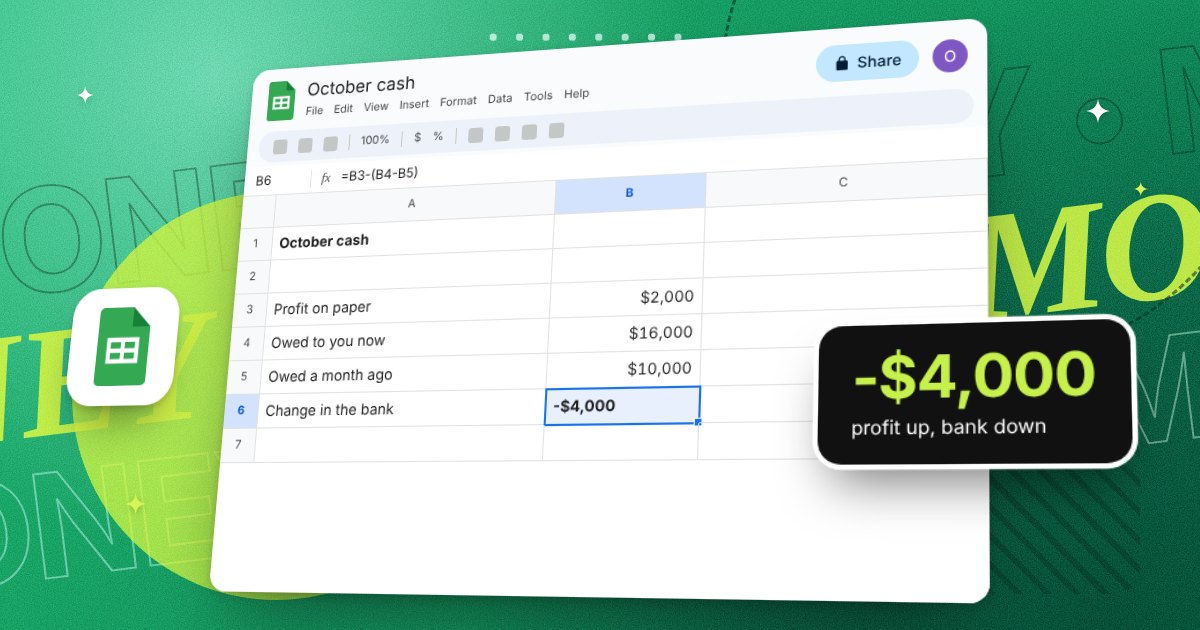
Sales are not profit, and profit is not cash. Line up three numbers for one month and the gap shows itself, usually in the wait to be paid.
Sales are not profit, and profit is not cash. When sales are up and the bank is empty, the money is in one of three places: it went on the cost of the jobs, it is sitting in invoices nobody has paid yet, or it was never there because the jobs were priced too low. You find out which by putting three numbers side by side for one month.
Here is the whole exercise with one business. I am making it up, so use your own figures. Say you run a small metal fabrication shop making gates and shelving, and you work in dollars.
01The month on paper
Last month you invoiced $16,000. This month you invoiced $20,000, which is 5 jobs at $4,000 each. That is 25% more, and it feels like a good month.
Now write down what this month's jobs and the running of the shop cost you:
- Steel and materials: $11,000
- Wages: $4,500
- Rent and power: $1,800
- Fuel, tools and everything else: $700
That is $18,000 in costs. Take it from the $20,000 you invoiced and you are left with $2,000. Last month, with $8,500 of materials and the same $7,000 for everything else, you were left with $500. So on paper you are $1,500 better off.
That is the first number to know: profit on paper. Sales minus what it cost to do the work and run the place.
02Where the extra sales went
Look closer at that $1,500. Sales went up by $4,000, but materials went up by $2,500. So of the extra $4,000, you kept $1,500.
Materials were about 53% of your sales last month and 55% this month. The new jobs were a little heavier on steel, and you quoted them at the same rate as the lighter ones. Nothing dramatic happened. The extra work simply paid less than the old work, and the shop is a little busier for it.
If your sales are climbing and profit is not climbing with them, check the cost of materials against the price on each job before you check anything else. It is the quickest leak to find, because the numbers are on your own invoices and supplier receipts.
03Why the bank went down anyway
You are $2,000 up on paper, yet the bank is $4,000 lower than on the first of the month. The gap is $6,000, and it is in unpaid invoices.
Go through the invoices:
- At the start of the month, customers owed you $10,000 from September.
- During the month, $6,000 of that came in.
- Of this month's $20,000, only $8,000 has been paid. The other $12,000 is waiting.
So customers paid you $14,000 in cash this month ($6,000 plus $8,000). Meanwhile you paid out $18,000 for steel, wages, rent and the rest. Steel is paid for when you buy it, before the gate is built, and most customers pay 30 days after you deliver, though some pay a deposit or pay early.
Now add up what is owed to you at the end of the month: $4,000 from September, plus $12,000 from October, is $16,000. A month ago it was $10,000. It grew by $6,000, and that is the gap between the $2,000 profit and the $4,000 drop in the bank. It is the third number: what customers owe you.
Every dollar of profit that is still in an unpaid invoice is a dollar you cannot spend on steel.
This is the second number: cash in minus cash out. It is the real change in your bank, not the one on paper.
04Two problems, two different fixes
For this shop, there are two separate problems, and they need different fixes.
The first is margin. The extra jobs keep too little. The fix is in the price, or in what you buy, or in which jobs you say yes to. My post on what an hour of your time is worth works through the same kind of sum for your own hours.
The second is the wait. Growing 25% while customers pay in 30 days means you need more cash to fund the same cycle. The faster you grow, the bigger the hole, unless the money comes in sooner. The fixes here are plain: ask for a deposit before you buy the steel, send the invoice the day the job is delivered, and phone the customers who are late on day 31, not day 60.
I will be straight about one thing. Neither fix is free. A deposit can lose you a customer who wanted to pay later. Chasing takes your time. But you can only decide whether the trade is worth it once you can see the numbers.
05The three numbers to write down on the first of each month
This takes 20 minutes with your invoices and your bank statement.
- 01Profit on paper. What you invoiced last month, minus what the jobs and the business cost. If you cannot work out what the jobs cost, that is the first thing to fix.
- 02Cash in minus cash out. What actually arrived in the bank, minus what left it.
- 03What customers owe you, and how old it is. The total unpaid, and how much of it is more than 30 days old. Compare it with last month.
If profit is up and the bank is down, the third number will tell you why. If profit is flat even when sales are up, the first will.
06What to do this week
- 01Pick last month. Write down sales, then every cost, and work out the profit on paper.
- 02Open your bank statement and work out how much more or less you have than on the first.
- 03List every unpaid invoice with its date. Total the ones older than 30 days.
- 04Ring the three oldest customers today. Ask when they will pay, and write down the date they give you.
- 05Put the three numbers in a sheet, one row a month, and fill in the next row on the first.
Next month you will be looking at the numbers instead of guessing.
Keep reading
What Is an Hour of Your Time Actually Worth?
Divide what you need to earn by the hours only you can do. The number is higher than you think, and it tells you what to hand off first.

A Customer Is Angry on WhatsApp. What Do I Say First?
Reply within the hour, repeat the problem in their words, say what you will do and by when. Leave the argument about blame for later.
One useful email a week
What is working in real businesses right now, written for owners. No spam, and one click to leave.
We only use your email to send the newsletter. See the privacy policy.
Want this working in your business?
Book a free 15 minute call and we'll tell you where AI can pay off for you. No pitch.
Book a Free Call