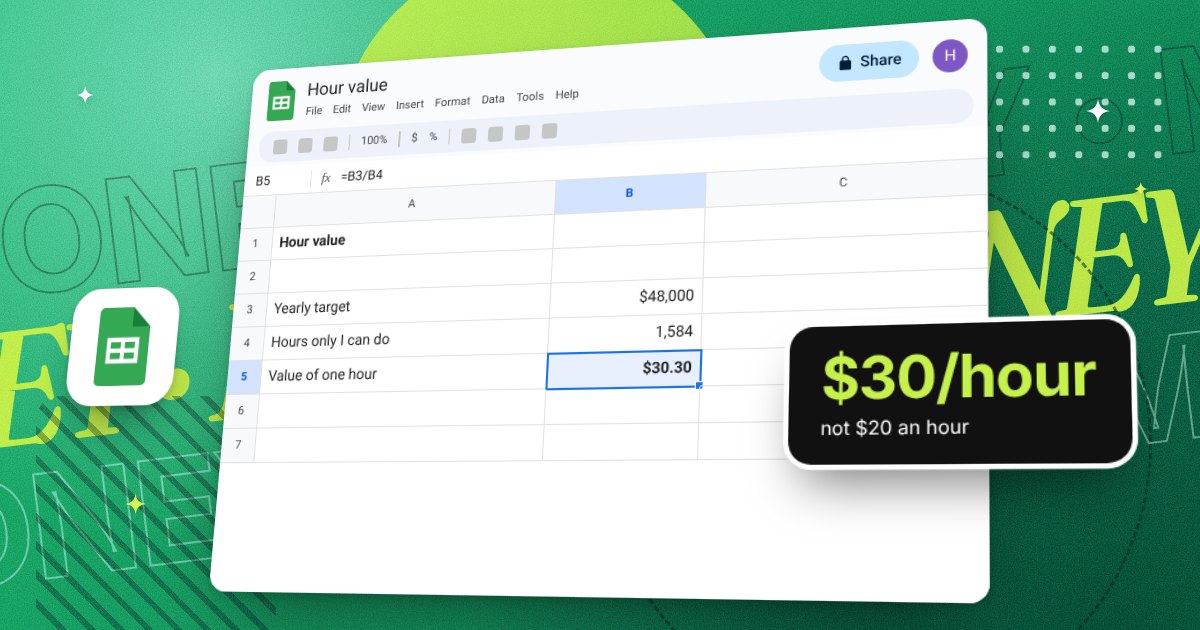
Divide what you need to earn by the hours only you can do. The number is higher than you think, and it tells you what to hand off first.
Take what you need the business to pay you in a year. Divide it by the hours you spend on work only you can do, not by all the hours you work. That number is what an hour of your time is worth, and it is higher than the figure you get by dividing by every hour you work.
The gap between the two is why a 50-hour week can still feel like falling behind. Here is the sum, step by step.
01Step 1: Pick the yearly number
Start with what the business needs to earn from you. That means your pay, plus anything you want to put aside for yourself.
I am making up the numbers below, so swap in your own. Say you run a print shop with 5 staff, and you want to take home $48,000 a year.
02Step 2: Count your real hours
Be honest about the week. Say you work 50 hours, and you take 4 weeks off, so you work 48 weeks. That is 2,400 hours a year.
The naive answer is $48,000 divided by 2,400, which is $20 an hour. It is the usual shortcut. It is the wrong number, because not all of those hours are doing the same job.
03Step 3: Take out the hours that do not count
Go through last week and sort every hour into one of two piles. The first pile is work that only you can do: pricing a big job, handling the customer who is about to leave, deciding what to buy, training your best person. The second pile is work that someone else could do, or that should not exist at all.
In our print shop the second pile looks like this each week:
- 8 hours of admin: invoices, supplier emails, filling in the same details twice
- 5 hours of chasing: late payments, customers who have not sent artwork
- 4 hours of rework: fixing jobs that went out wrong because the brief was unclear
That is 17 hours. Your pile will be different, but write the week down on paper and see how big it is.
Take 17 from 50 and you have 33 hours a week of work only you can do. Over 48 weeks that is 1,584 hours.
04Step 4: Do the division again
$48,000 divided by 1,584 is about $30.30.
That is the real value of an hour of your time in this business. You were treating an hour as $20, and you were spending 17 of them every week on work that does not need you.
Every hour you spend on a job someone else could do is an hour you did not spend on the job only you can do.
05Step 5: Use it to decide what to hand off
Now you have a way to choose. Look at the second pile and ask two things about each item: what would it cost to hand off, and what would you do with the hours?
Say you find someone to take the 8 hours of admin at $8 an hour. Over 48 weeks that is 384 hours and $3,072. Those 384 hours at $30.30 are worth about $11,600, if you really spend them on the work only you can do.
That last part is the catch. If the freed hours go to more email, the sum does not hold. It works only when the hours go into pricing, selling, or fixing the process that causes the rework. Decide where they go before you hand anything off.
In this example, rework may be the best place to start. Four hours a week of fixing wrong jobs also costs materials and reprints. Say a one-page order form gets the brief right the first time. That is a small job set against four hours every week.
06Two things this number does not tell you
First, it does not tell you what to charge. Your price depends on your costs, your market and what customers will pay. What it does tell you is whether a job is worth your time at the price you quoted. A job that pays you $20 an hour of your own time is a poor use of a $30 hour.
Second, it is not tax or financial advice. If you are working out your pay, how much to draw, or what the business can afford, talk to your accountant.
07What to do this week
- 01Write down every hour you work this week in two columns: only I can do this, and someone else could.
- 02At the end of the week, add up each column.
- 03Multiply your first-column hours by the weeks you work, then divide your yearly number by that.
- 04Pick the biggest item in the second column. Write down what it would cost to hand off and what you would do with the hours.
- 05Hand off that one item next week. Leave the rest for later.
If chasing customers is on your list, my post on stopping the loss of price enquiries on WhatsApp covers one of the usual leaks.
Keep reading
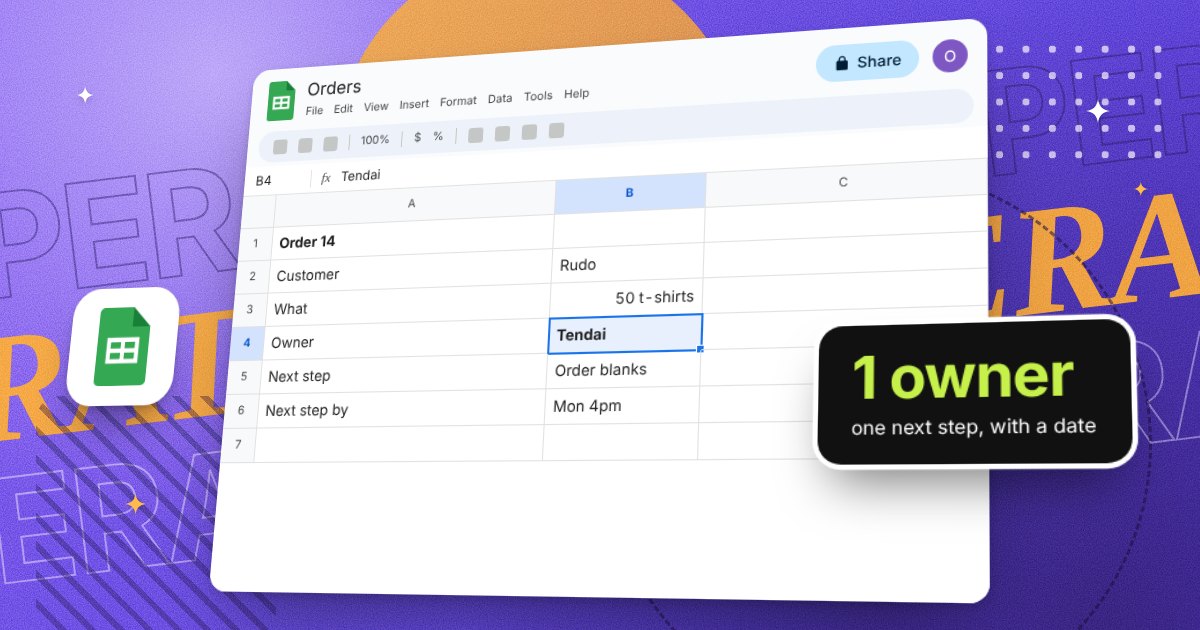
How to Stop Orders Falling Through the Cracks
Give every order one line in one shared place, with one named owner and a dated next step. Here is the sheet, and an example order that nearly got lost.

What Should a Weekly Report Show an Owner?
Five numbers on one page, the same every week. Here is the page, filled in for an example salon, and what the owner does after reading it.
One useful email a week
What is working in real businesses right now, written for owners. No spam, and one click to leave.
We only use your email to send the newsletter. See the privacy policy.
Want this working in your business?
Book a free 15 minute call and we'll tell you where AI can pay off for you. No pitch.
Book a Free Call