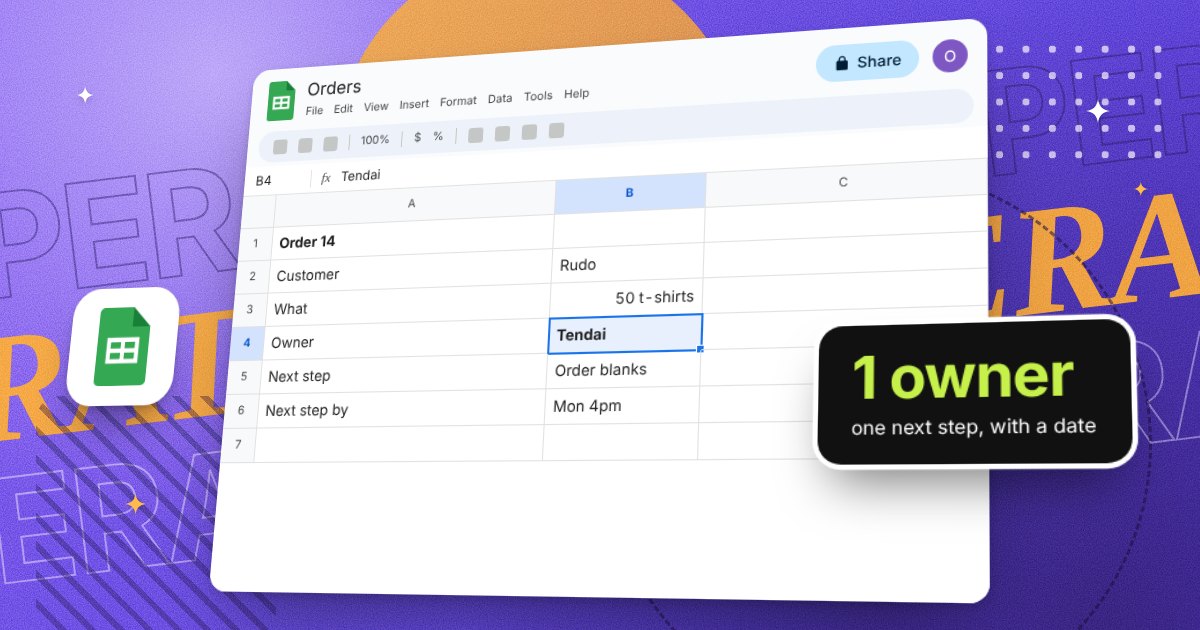
Give every order one line in one shared place, with one named owner and a dated next step. Here is the sheet, and an example order that nearly got lost.
Give every order one line in one shared place. Each line has one named owner and one next step with a date. Then, every morning, read the lines that are more than 2 days old. That is the whole fix, and it works with a paper book as well as a spreadsheet.
Orders get lost when the order lives in a WhatsApp chat, a phone call, a scribble on a till slip and somebody's memory. Each person who touched it thinks someone else has it.
01How an order gets lost
The business below is made up, and so are the names and prices. It is a small print shop. Say the owner is Tendai, and Farai works the counter and answers the phone. Prices are in US dollars.
On Monday at 10:05, Rudo messages the shop on WhatsApp. She wants 50 printed t-shirts for a church event on Friday, at $6 each. Farai replies "yes, no problem" and says he will tell Tendai.
Farai mentions it to Tendai on the way past the printer. Tendai hears "Rudo wants shirts" and says "good". Farai takes that as Tendai ordering the blank shirts. Tendai takes it as Farai handling the order. Nobody writes anything down.
On Wednesday afternoon Rudo asks if her order is on track. It is not. No blank shirts have been bought, and the supplier closes at 1pm on Thursdays.
Nobody did anything wrong. Two people each thought the other had it.
02The sheet
Make one shared sheet. A Google Sheet works. So does an exercise book kept by the till, if everyone who takes orders is in the same room. It needs seven columns.
- Order. A number, so you can say "order 14" and everyone knows which.
- Customer. Name and phone number.
- What. The item and quantity, in the customer's own words.
- Due. The day the customer expects it.
- Owner. One name. Not "Farai and Tendai". One person.
- Next step. The very next thing that has to happen, in plain words.
- Next step by. The date, and the time if it matters.
Here is Rudo's order on Monday at 10:10, five minutes after Farai said yes.
- Order: 14
- Customer: Rudo, 077 000 0000
- What: 50 t-shirts, printed, church event
- Due: Friday
- Owner: Tendai
- Next step: Order 50 blank shirts from the supplier
- Next step by: Monday, before 4pm
Farai wrote the line while Rudo was still in the chat. Tendai read it and said "mine". The owner column is the point. A line with two names, or no name, is how orders fall through.
03Two rules that make it work
The first rule is that the order is not accepted until it is on the sheet. Not in someone's head, not in a chat, on the sheet. If a customer rings the owner directly, the owner puts the line on the sheet before the call is forgotten. It will feel slow at first.
The second rule is that the owner moves the next step forward every time they finish one. When Tendai orders the shirts, he changes the line to "Print when blanks arrive" and sets the date. A line is never left saying a step that has already happened.
If you take orders in several places, WhatsApp, calls, email and walk-in, the sheet is what joins them up. My post on stopping lost price enquiries on WhatsApp covers the earlier step, replying quickly. This post covers what happens after the customer says yes.
04The morning check
Every morning, one person spends 10 minutes on the sheet. Sort the sheet by the "Next step by" column. Look for two things.
- Anything past its date. Ask the owner what happened and set a new date.
- Anything that has not changed in 2 days. A line that has sat untouched for 2 days is a line to ask about, even if its date is still ahead. Ask the owner when they last touched it.
On Tuesday morning, a check like this would have caught Rudo's order. Tendai's step was due Monday before 4pm, and it was still there. He would have been asked, bought the shirts that day, and been calm on Wednesday when Rudo asked.
Who does the check matters less than that it is always the same person and always the same time. If the owner does it, it is the first thing to drop on a busy day. A senior member of staff who is in early every day is a better choice.
05When it goes wrong
Expect these problems early.
- People skip the sheet when they are busy. Do not tell them off. Ask what made it hard, and fix that. If the sheet is on a laptop in the back, move it to a phone.
- Next steps are vague. "Sort it out" is not a next step. "Phone the supplier about the blue ink" is. If the next step cannot be done in one sitting, it is two steps, so write the first.
- Lines pile up after they are finished. Move finished lines to a second tab on Friday. Do not delete them. A year from now, you will want to know what you sold and when.
06What to do this week
- 01Make the sheet with the seven columns, and share it with everyone who takes an order.
- 02Put every open order on it today, even the ones you are sure about. Give each one an owner and a dated next step.
- 03Tell staff the rule: an order is not accepted until it is on the sheet.
- 04Pick the person and the time for the morning check, and do it tomorrow.
- 05After one week, count how many lines the morning check had to ask about. That number tells you where the delays were hiding.
Once the sheet is in use, you stop being surprised on Wednesday afternoon. If you want help setting it up around how your shop or office really runs, that is the kind of work on my services page.
Keep reading
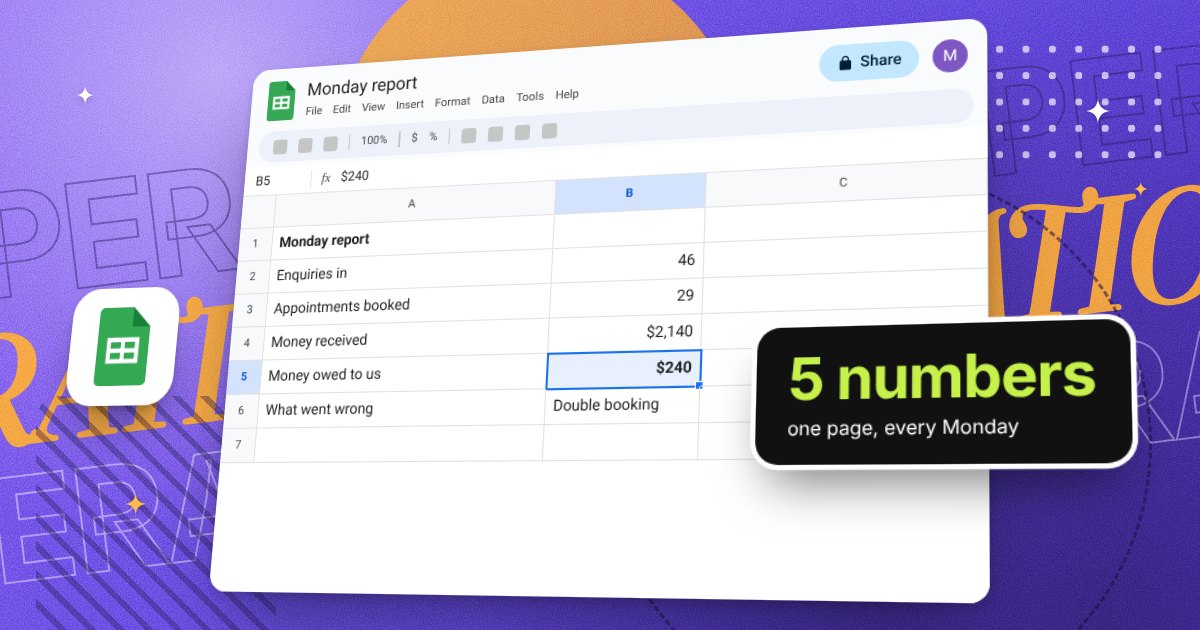
What Should a Weekly Report Show an Owner?
Five numbers on one page, the same every week. Here is the page, filled in for an example salon, and what the owner does after reading it.
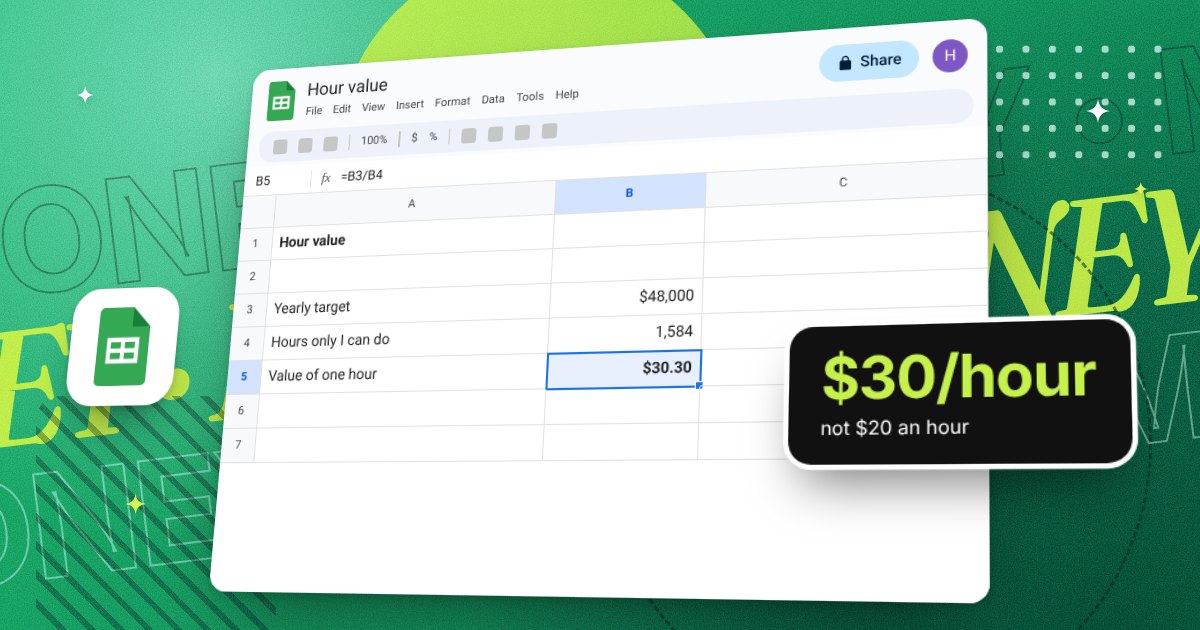
What Is an Hour of Your Time Actually Worth?
Divide what you need to earn by the hours only you can do. The number is higher than you think, and it tells you what to hand off first.
One useful email a week
What is working in real businesses right now, written for owners. No spam, and one click to leave.
We only use your email to send the newsletter. See the privacy policy.
Want this working in your business?
Book a free 15 minute call and we'll tell you where AI can pay off for you. No pitch.
Book a Free Call