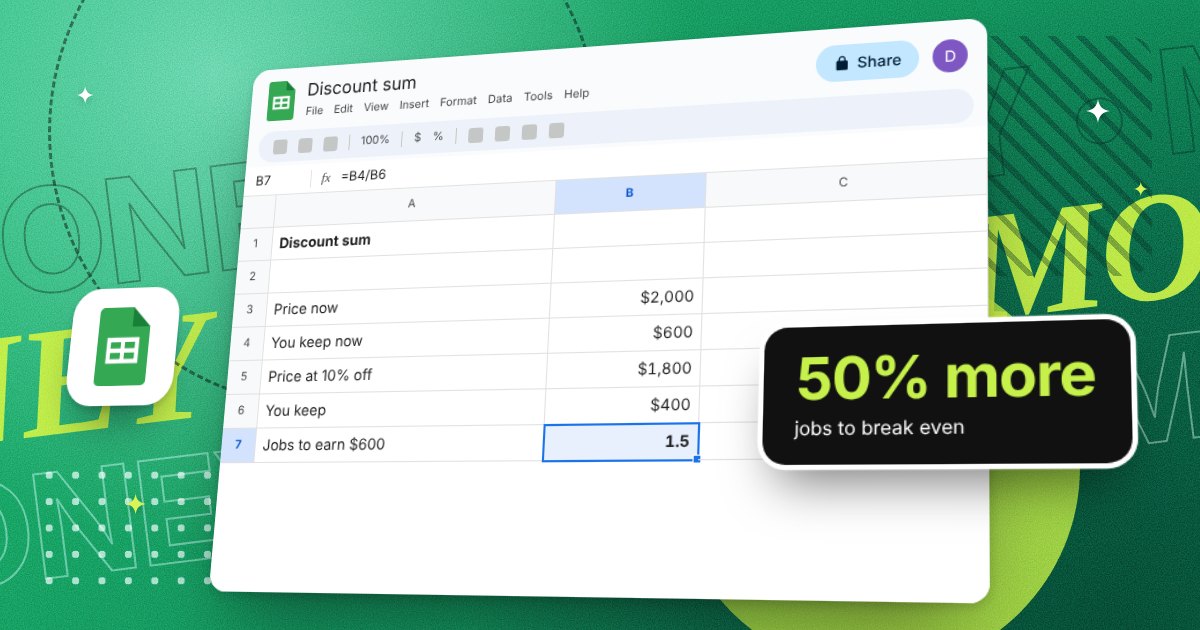
A discount with nothing asked back is a pay cut. Work out how many extra jobs it must win to break even, then trade it for something.
Only after you have worked out what the discount costs you, and only in exchange for something. A discount with nothing asked back is a pay cut. It comes straight out of your margin, which is the small part of the price that you actually keep, so it hurts more than it looks.
Here is the sum, with a job I am making up. Use your own figures.
01What does a 10% discount really cost?
Say you run a small painting business and you work in dollars. A customer asks for a quote on a house. You price it at $2,000.
Your costs on that job are $1,400. That is $700 in paint and materials, and 20 hours of your team's time at $35 an hour. So you keep $600, which is 30% of the price.
The customer says, "Can you do better on the price?" You say 10% off, because it feels small. The price becomes $1,800. Your costs are still $1,400, because the walls do not get smaller. You now keep $400.
A 10% discount on the price took one third of your margin. Look at it that way and the question changes. You are not giving away $200 of $2,000. You are giving away $200 of the $600 you keep.
02How many extra jobs must it win?
To earn the same $600 you used to earn from one job, you now need 1.5 jobs at the discounted price. That is 50% more work, for the same money.
Here is the same job at other discounts:
- 5% off: you keep $500, so you need 20% more jobs to stand still.
- 10% off: you keep $400, so you need 50% more jobs.
- 15% off: you keep $300, so you need twice as many jobs.
- 20% off: you keep $200, so you need three times as many jobs.
Now ask yourself honestly whether a 10% discount will bring you half as much work again. If it will not, it only wins the one job in front of you. Give it to every customer who asks and you are working harder for the same money, or for less.
The price comes down, but the cost of the work stays exactly where it was.
03Why thin margins make it worse
The lower your margin, the faster a discount eats it. Here is a second example, also made up. A small cleaning company in Australia prices an office clean at A$1,000. Costs are A$850, so it keeps A$150, which is 15%.
A 10% discount brings the price to A$900 and the margin to A$50. To earn the same A$150, the company now needs 3 jobs where it used to need 1. That is two extra jobs just to stand still.
Margin decides everything, so work out yours before you talk price. If you are not sure what an hour of your own time is worth in that margin, start with what an hour of your time is really worth.
04What should you ask for in return?
Sometimes a discount is the right call. The job fills a quiet week, or the customer will send you three more. The rule is that a discount is never free. It is a trade, and you say what you want back. Three trades that are worth having:
- Faster payment. Ten per cent off if half is paid before you start, or the rest on the day you finish. You carry less risk and wait less for your money.
- A bigger order. The discount applies to the second job, but only if the customer books it now. The second job keeps only $400, but it is $400 you would not otherwise have had.
- A referral. You give the discount once the customer has put you in touch with someone else who needs the work, or has left you a review.
If the customer will not give you anything back, you have learned something. They wanted a lower price and offered nothing for it.
05What can you say instead of yes?
Saying yes straight away is easy, and "no" can feel rude. Here are three replies you can send on WhatsApp instead. Change the numbers to yours.
- 01"I can come down to $1,900 if you pay half before we start. Shall I send the deposit details?"
- 02"I keep my price on a single job, but if you book the hallway as well this month I can take 10% off the second one."
- 03"That is the best price I can do for this scope. If you want to lower it, I can leave out the second coat on the ceiling. Would that help?"
None of these is a refusal. Each one tells the customer there is a price and a way to change it. If they want the work, they will answer. If you are losing people at the price stage, how to stop losing people who ask for a price on WhatsApp covers the first reply.
06What to do this week
- 01Pick your last 5 jobs and write down, for each, the price, your costs and what you kept. Work out the margin as a percentage.
- 02For each one, work out how many extra jobs a 10% discount would have to win to break even.
- 03Write down the lowest price you will take on a normal job. That is your costs plus the margin you need. Do not go under it without a trade.
- 04Save the three replies above in your phone, with your own numbers, so the next time someone asks you can paste one in.
If you want a second pair of eyes on where your jobs lose money, see what I do.
Keep reading
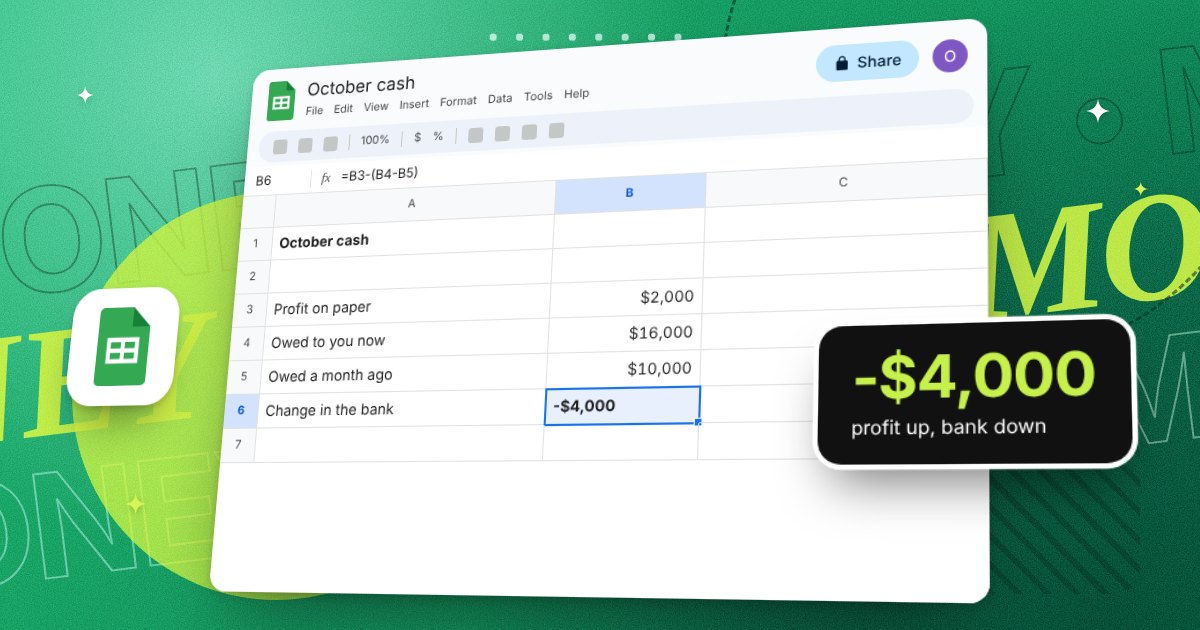
My Sales Are Up but There Is No Money. Where Did It Go?
Sales are not profit, and profit is not cash. Line up three numbers for one month and the gap shows itself, usually in the wait to be paid.
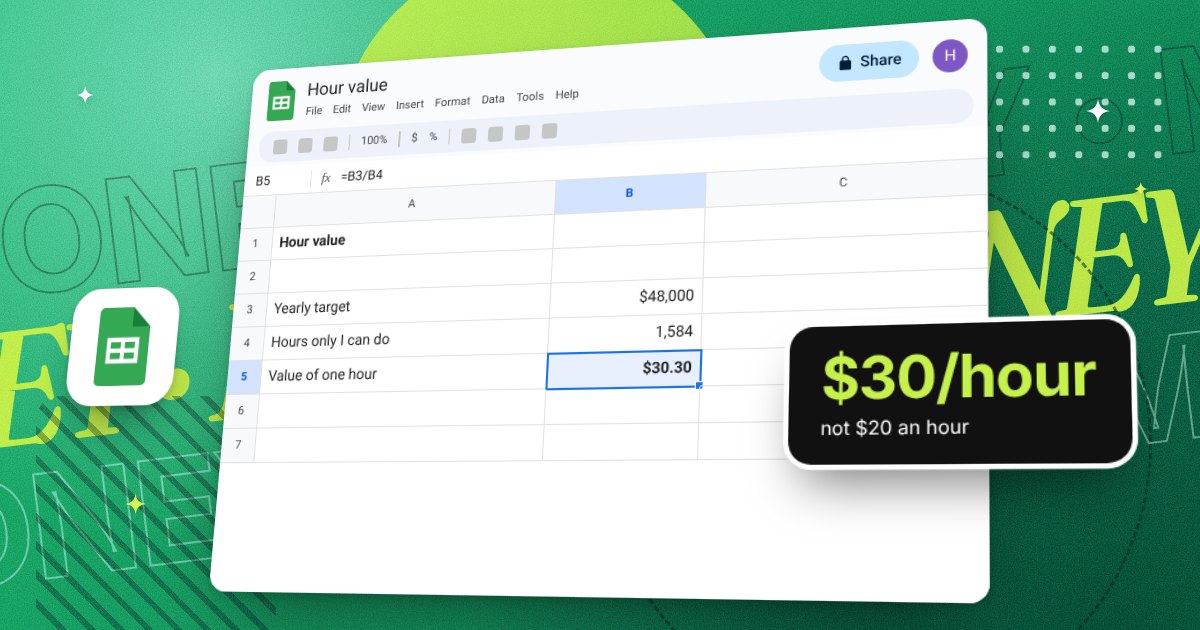
What Is an Hour of Your Time Actually Worth?
Divide what you need to earn by the hours only you can do. The number is higher than you think, and it tells you what to hand off first.
One useful email a week
What is working in real businesses right now, written for owners. No spam, and one click to leave.
We only use your email to send the newsletter. See the privacy policy.
Want this working in your business?
Book a free 15 minute call and we'll tell you where AI can pay off for you. No pitch.
Book a Free Call